24 Kasım 2013 Pazar

Home Type Generators


Our everyday life depends on the continuous flow of electricity probably more than we realize. While a few hours without power may be just an inconvenience, losing it for days or even weeks can be costly and life threatening. 

Besides spoiled food, an ordinary blackout may result in the loss of central heat in the winter, the loss of air conditioning in the summer, a flooded basement, inoperative security systems, and a faltered business. All of the above are good reasons to consider some kind of an emergency power source for your home. If you do an online search for home generators, you will find models for sale ranging anywhere from $120 into thousands of dollars. Which type do I need for power outages? Why would I pay $4,000 for a permanent electric genset plus $2000-$5000 for the installation when I can buy a portable one for $600-$1000 and run a bunch of extension cords? These are the commonly asked questions. In this guide I'll answer these questions and provide you with practical facts and information you need to know to buy the right system for your home.

AVAILABLE TYPES 
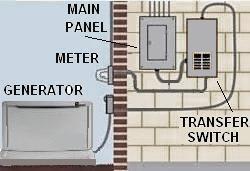


You probably know already that there are two basic types of home generators: stationary and portable. They are often called gensets because they are actually the sets comprising of an alternator and an engine.

Unfortunately, the numerous buying guides and articles available everywhere do not always emphasize all the drawbacks and the issues associated with each of these types. Before going over the details, let's start with a quick background information. 


Stationary (standby) systems are permanently connected to your house and hooked up to a fuel source. Normally this would be the same source you use for the heating: natural gas, propane or diesel. An indoortransfer panel isolates home wiring from input lines during utility power failure (see simplifed connection diagram). The wattage of the available air cooled standby systems intended for home use ranges from 6 kilowatt to 20 kW, so you can always select the right model that can supply the whole house including central a/c, sump pump, etc. In automatic mode such a system will start by itself without your involvement when it detects a power interruption. Likewise it will shut down when utility voltage is restored.


Portable devices range from 500 W to almost 20,000 W. When you need to use a portable genset, you have to moved to the place where you want to use it, fill with fuel and start up. Then after a short warm up period you can connect it to your equipment. There are no auto start portables. Gasoline and diesel models come with an on-board fuel tank; propane and natural gas models have to be connected to an external tank or fuel line. All the devices with an on-board tank have to be refueled several times a day if you load them to their maximum capacity.

All engine-driven units can be run only outdoors. A stationary device always sits outside just like a central a/c. A portable one is normally stored elsewhere and connected only when you need to use it. There are detailed descriptions and reviews of different generators in our SMPS site. Here we will just discuss the basics.


PROS AND CONS OF DIFFERENT TYPES 

As you realize, all types of gensets have pros and cons. Fixed systems provide the highest level of comfort, but of course it comes with a price tag. Depending on wattage and options, complete systems with a changeover switch may sell for $2000 to $5000. You may also need to spend several thousand dollars for electrical wiring and fuel hook up. Before the installation, you will likely need to obtain permits from your utilities and pass the inspections after the work is done. All this, obviously, takes time. So, if you are looking for an emergency generator because there is a hurricane or an ice storm in tomorrow's forecast, it is too late to consider a standby type. Another issue is service. A hard-wired appliance that weights 400-500 pounds is not something you can easily disconnect and ship back or bring to a repair shop. Should you need a repair, you'll have to wait for a service technician to come to your place or for the manufacturer to send you a replacement part. 

Portable generators are much cheaper-- their prices start at around $120 for a 1000W model. Unlike stationary devices, they don't have to be hardwired to your house unless you choose to-- their control panel has several outlets of various types into which you can plug cables from your electric loads. This can be both an advantage and a disadvantage. On one hand, you can start using such device, so to speak, right out of the box. However, this would work only if you want to run "cord and plug" appliances, such as refrigerators and window air conditioners. You can just unplug them from the wall outlets and connect via extension cords to the generator. However, when it comes to lights, furnaces and everything else that is wired directly into your house electrical lines, you'll face problems powering them up. This is something homeowners often don't realize while dealers may neglect to mention to you. You might ask, why can't I just hook up my genset to a wall outlet? First of all, it is illegal and dangerous to connect any voltage source into any electrical wiring connected to the grid. By trying to energize your house you are also feeding voltage back into the utility lines. This may hurt line workers or your neighbors who may think the mains is down. Aside from this, unless you are the only one who lost power, you would actually be trying to power up all the neighbors houses who lost electricity. This would likely overload your generator and trip its circuit breaker. Because of all of the above, if you want to run your built-in appliances and lights from a portable backup source you still need a redundant switch. In this case it has to be a manual one though. Such a connection is the safest one, but you would still have to deal with the professional installation, permits, inspections, etc. Technically, it is possible to isolate your house wiring by flipping the main circuit breaker to OFF position. However it leaves a possibility of a human error and is not recommended (see portable generator connection for more details and wiring diagrams). 

You would also have another hurdle to overcome if you buy a portable model equipted with GFCI and grounded neutral. In such a model the GFCI will trip when you use it with a regular transfer switch. This is something the manufacturers and retailers may not always mention you. So, if you choose a genset with GFCI, you need to buy a special 3-pole transfer switch or otherwise discounnect genset's ground wire in the transfer switch. In any case, such a setup is still cheaper than a stationary for two reasons: because portables cost less than standbys and because manual switches cost less than automatic ones. In case of emergency, if you have no choice and you really need to connect your genset into a wall outlet, first flip the "disconnect switch" on the main service panel. This would isolate your house from the outside lines. This is not a recommended method though. You also need to remember that a standard outlet is rated for 15A. So, you can't use it for more than 120x15=1800 volt-amps. If you draw a higher current you may overheat the socket and the wires, which is a fire hazard.

WHAT GENERATOR DO I NEED? 


My pick for standby genset for a typical house with a central a/c: Generac Guardian 17 kW home generator model 5873. (An included 100A auto transfer switch is installed indoors).


Well, buying the right model for the home involves several key decisions:


How much power do you need?


How soon do you need to use it? 


How often do you expect to use it and for what duration of time?


Are you able to move around a few hundred pound device?


Here is when you definitely need a standby home generator system: 
Your house requires more than 17 kW power, or 
You want to be prepared for long-term power outages, or 
You want fully automatic operation, or 
You don't want to move around a heavy device. 

Here is when you should buy a portable genset: 
You need emergency power immediately; 
You are looking to spend less than $1,500 (maybe even a few hundred dollars). 

In all other cases, either type might work for you. You just need to choose between cost and convenience.

For standby gensets, my pick is the Generac Guardian® series available in the range from 8 kW and 45 kW. For my advice on portables, see my picks of best portable generators for home. For more buying choices also see my guide to cheap generators.

Whatever genset you choose, remember that all engine driven devices have a common disadvantage- they all require maintenance, such as frequent oil changes. If you don't feel like getting involved into this, you may want to consider a maintenance-free battery backup solution. More details are provided in my review of different types of power generators, which compares traditional and alternative power systems. If you are interested in "green" energy, check out the tutorials on residential wind generator and to solar-powered system.

Diesel Genset Installation (Indoor)

Diesel Genset  Installation (Indoors)

Basics of VRLA Technology


Source: BAE Energy From Batteries

In the gaseous phase, oxygen gas migrates to the negative plate where it is reduced  to oxygen ions (O2). In the meantime, hydrogen protons (H+) are being transported  in the electrolyte to the negative plate as well. At the negative plate the oxygen  and hydrogen combine again to form water. Known as the internal oxygen cycle, this  process is called recombination of the electrolyte and defines the principle of VRLA methodology. It is based on the principle that “the oxygen evolution rate at the positive electrode and the oxygen-reduction rate at the negative electrode balance each other.”5

Not to oversimplify or appear to be too repetitive, but as most who work with  batteries on a regular basis know, in a vented lead acid (VLA) flooded cell, during  float and discharge, oxygen gas is released from the cell and the hydrogen ions  move in the electrolyte to the negative plate. There it is reduced to hydrogen gas. 
Some of the oxygen gas does find its way to the negative plate where it can be recombined with the hydrogen gas and reform into water. But both the oxygen and the hydrogen gasses not recombined are released and leave the cell via the openings in the flame arrestor. This action results in a slow water loss, but eventually these cells have to be refilled with distilled or ionic water. Of course, one of the advantages of a VLA cell is that this event can be monitored and controlled, assuring that the cells remain filled with the correct amount of electrolyte, contributing to their extended service life. 

With valve-regulated lead-acid (VRLA) cells, there are actually two distinct actions: [1] a liquid one in which the hydrogen ions are transported via the electrolyte and [2] a gaseous one. Both play an important role in the performance of the VRLA cell. 

In the valve regulated cell, the water is diffused back into the mat or gel. However, it is important to note that the internal oxygen cycle generates water from the oxygen and the hydrogen protons, not the hydrogen gas. This is important because it shows that hydrogen gas is not removed by the internal oxygen cycle.6

Dr. Rusch points out that while this is true, 5-10% of the hydrogen ions are still reduced to a gaseous state, and this small amount of hydrogen is released through the pressure sensitive release valves

In the VRLA process, the electrolyte is mobilized in one of two ways, depending  upon the type of VRLA being considered. 

1. The Absorbed Glass Mat (AGM) VRLA utilizes a microporous felt known as a  glass mat to immobilize the electrolyte. The electrolyte then fills the smaller pores of the mat by capillary action, but a good portion of the larger pores remain unfilled. Specific gravity also plays a role here, but we’ll deal with that in a moment. 

2. The Gelled Electrolyte (GEL) forms by the addition of silica dioxide (SiO2) to the sulfuric acid (SO4) and water (H2O). In this type, the gel shrinks which open crevices that run through the electrolyte. Void space is available around the electrodes, allowing fast transport of the oxygen gas. 

Obviously, the question we need to ask and answer today is: what are the differences between these two forms of VRLA cells, and what are the resulting pluses and minuses of each in today’s context?

22 Kasım 2013 Cuma

Generator Control Panel


Controlling our machines
Any complex piece of machinery requires a user interface to enable the user to monitor its operations, check for efficient functioning, and intervene when required. Machines overheat, slow down, speed up or generally vary in their performance based on numerous factors such as fatigue, weather conditions, and the wear and tear of components and parts.
In electrical machines, like generators, these varying changes constitute an electrical signal.  Additional information about generators and their components can also be found in the article, How Generators Work.  These signals can be intelligently processed to control the performance of the machine.  A lot of machines in urban environments (such as signal lights and automatic doors) are completely self-managed due to such controllers. They have sensors that can detect changes in physical attributes like heat and speed and generate signals accordingly. Modern generators also have similar sensors to detect changes in all kinds of various parameters. These can be used to control the generator through a control panel.
The Control Panel – what is it?

Control Panel in Diesel Generators

Visually, a control panel is a set of displays that indicate the measurement of various parameters like voltage, current and frequency, through gauges and meters. These meters and gauges are set in a metallic body, usually corrosion proof, to protect from the effect of rain or snow. The panel may be set up on the body of the generator itself, which is usually the case with small generators. If they are mounted on the generator, they typically have vibration proof pads that help isolate the control panel from shocks. Control panels for a larger industrial generators can be completely separate from the generator and are typically large enough to stand upon their own. These units may also be shelf-mounted or wall-mounted next to the generator, which is common inside an enclosure or intental application like a data center.

Control panels are usually fitted with buttons or switches that help to operate the generator such as a switch-off button or turn-on key. The switches and gauges are usually grouped on the basis of functionality. This makes the panel friendly and safe for use since it minimizes the possibility of an operator accidentally selecting or executing the wrong control. Imagine trying to shut down a vibrating generator with a spring loaded lever in the middle of the night and you will appreciate why having a simple cut of switch at the control panel makes sense.
How does it work?
The control panel is becoming an increasingly complex piece of electronics with a microprocessor that can manipulate input from sensors to help give feedback to the machine to manage itself. One such feedback could be the temperature, indicating overheating, other examples would be over/under speed and low/high oil pressure. Typically, a heat sensor inside the generator would sense the build up of heat in the generator body and pass this to the microprocessor in the control panel. The microprocessor will then take effective measures to regulate the performance of the machine including shutdowns if, for example, the oil pressure is too low or the coolant temperature is too high, leading to buildup of heat. In industrial situations, this functionality of control panels is becoming increasingly critical. The microprocessor or microcontroller is embedded in the circuitry inside the control panel and is programmed to take in the sensor input and react to that with the programmed control rules. 
Control panels can be combined with an Automatic Transfer Switch (ATS) to maintain the continuity of electrical power. The ATS detects an outage of power when your local grid fails. It signals the control panel to start the generator. Depending on the type of generator being used, the control panel may activate glow plugs (for diesel) for an adjustable length of time. It will then start the generator using an automatic starter, similar to the one you engage when you turn the keys in the ignition of your car in the morning. As soon as the engine of the generator reaches an optimum speed, the starter is disengaged. The ATS then switches to the generator power, and you can go back to business as usual, without having to frantically scramble to figure out what caused power loss. This aspect of a control panel makes it extremely useful in homes during bad weather and in industrial situations for ensuring mission-critical continuity.
Custom Control Panels
Control panel units are usually designed and produced by the manufacturer of your generator. Most generators have integrated control panels that are embedded with the product. 
Some of the common things today’s control panels offer include; continuous digital readouts, large character LCD screens, displays with running time, oil pressure and water temperature sensors, set points and custom message options, wiring harnesses, remote and local start/stop capabilities, and of course shut-down capabilities.

You may have special requirements above and beyond the common feature set included with the standard units, such as gauges and meters, very specific parameters to be monitored, a preference for LCD indicators as opposed to analog meters, automation requirements, and various other factors that are not typically provided by the generator manufacturer’s original control panel. In such a case, you can have a control panel custom designed and then fitted onto the generator, or look into purchasing one that meets your needs from a number of third-party vendors who specialize in control panels. Custom panels are quite popular in both industrial and residential generators. In addition to choosing a control panel the following article contains addtitional tips when buying a generator.  So, the next time you are evaluating a generator for your use, don’t forget to check out all the specifics on the control panel and the features it offers to make certain it will meet all the requirements for your specific needs.

Ventilation of Genset Room

Source: genset.info

Ventilation of the genset room is necessary to provide combustion air to the engine, remove the heat emitted from the genset and any other equipment in the room, and to remove any fumes. To prevent recirculation the radiator must be placed near the room outlet air port, connected, and sealed by flexible ductwork.
NOTE: The phrase “genset room” and the term “room” are used throughout this post. However, the principles discussed here are applicable to any means of enclosing the genset. For the purposes of this section, consider “room” synonymous with “powerhouse,” “housing,” “container,” “enclosure,“ etc.
Poor ventilation system design and/or installation can lead to the following problems:
• Hazardous conditions for genset room personnel (if applicable)
• High temperatures around the set that can lead to poor performance and overheating
• Poor operation in cold climates if the installation permits exposure of the unit to cold temperatures
• Issues with other equipment in the room that may be sensitive to high or low temperature.

Requirements
• Engine exhaust manifolds and turbochargers shall not be insulated.
• Rigid insulation shall not be used on expansion joints.
• Heat from other sources shall be considered in the ventilation system design.
• Room inlet / outlet shall:
• Accommodate the total combustion and ventilation airflow through the room.
• Permit airflow across entire genset from alternator end to radiator end.
• Draw/discharge ventilation air directly from/to outdoors.
• Permit the required amount of fresh air flow across each set in a multiple set installation.

• The louver manufacturer shall be consulted for air velocity limits.
• Radiator discharge ducts shall be self–supporting.
• Ventilation system shall be designed for acceptable operation with all entry / service doors closed. All doors shall remain closed during genset operation to maintain the designed ventilation flow.
• The crankcase breather line shall be routed such that vapors will not foul equipment.
• If the crankcase breather is modified, crankcase pressure shall be measured at rated power. Pressure must be positive but not exceed 3 inches of water (0.75 kPa).
• For set–mounted radiator / fan packages, genset room total airflow restriction shall not exceed the maximum value listed on the Generator Set Data Sheet.
• Louvers shall open immediately upon genset start–up for emergency / standby installations. In cold climates, louvers may open partially for combustion air only and controlled to modulate the temperature in the room.
• If a blocking wall is installed, it shall be located no closer than a distance equal to 1X the discharge louver height away from the building. For optimal performance, the wall should be located approximately 3X the discharge louver height away from the building.
• A turning vane and drain shall be included with any blocking wall installation.
• If ventilation system filters are installed, a system for detecting plugged filters shall be in place.

Recommendations
• Exhaust piping and mufflers should be insulated.
• Maximum outdoor temperature should be measured near the air inlet.
• Air velocity should be limited to 500 – 700 feet/minute (150 – 220 meters/minute) to prevent rainwater / snow ingress. See above requirement regarding louver limits on air velocity.
• Room inlet / outlet location recommendations.
• Inlet should not be located near engine exhaust outlet.
• Inlet and outlet should not be located on the same wall.
• Outlet should be located as high as possible and inlet should be located as low as possible, while maintaining fresh air flow across the entire set.
• Outlet should be located on downwind side of the building.
• Additional combustion equipment should not be located in the genset room.

Turkish Genset Companies

1- Teksan  www.teksangenerator.com    Quite competitive and professional company in terms of native capital. I highly recommend you to h...